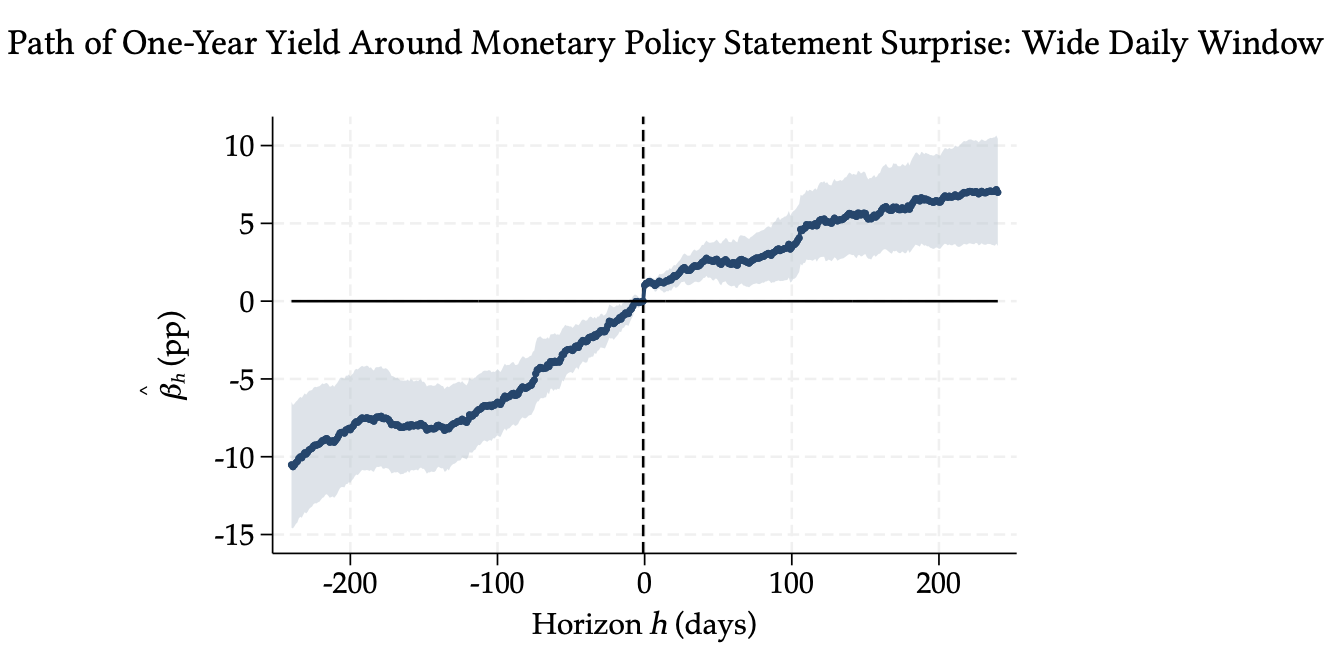
Abstract: How should high-frequency monetary policy surprises be used when the outcome of interest is only observed at a lower frequency? We first document a business-cycle endogeneity problem that arises when monetary policy surprises are aggregated to monthly or quarterly frequencies—surprise policy easings (resp. tightenings) tend to occur amid broader easing (resp. tightening) cycles. These low-frequency trends in pre-event Treasury yields are not reliably removed by standard controls without also weakening the relevance of the remaining policy variation. Motivated by this evidence, we next develop an alternative Q-theory-based approach for estimating the corporate investment response to monetary policy. Our approach combines high-frequency identification of firms' valuation responses to policy surprises with low-frequency firm-level investment-Q sensitivities. Our baseline estimate is: a one-unit monetary tightening, normalized to a one percentage point increase in the one-year Treasury yield, reduces the annual tangible investment of non-financial, non-utility public firms by 0.38% of GDP, with 24% of this effect driven by a novel firm-heterogeneity channel.